What Indie Children’s Authors Wish Parents Knew About Supporting Small Books
Most indie children’s authors are not asking parents to buy every book they write. They are hoping for something simpler and, in many ways, more powerful.
They are hoping that if a book genuinely helps your child, makes them laugh, gives them words, starts a conversation, calms bedtime, sparks curiosity, or becomes the one they ask for again, you will help the next family find it too.
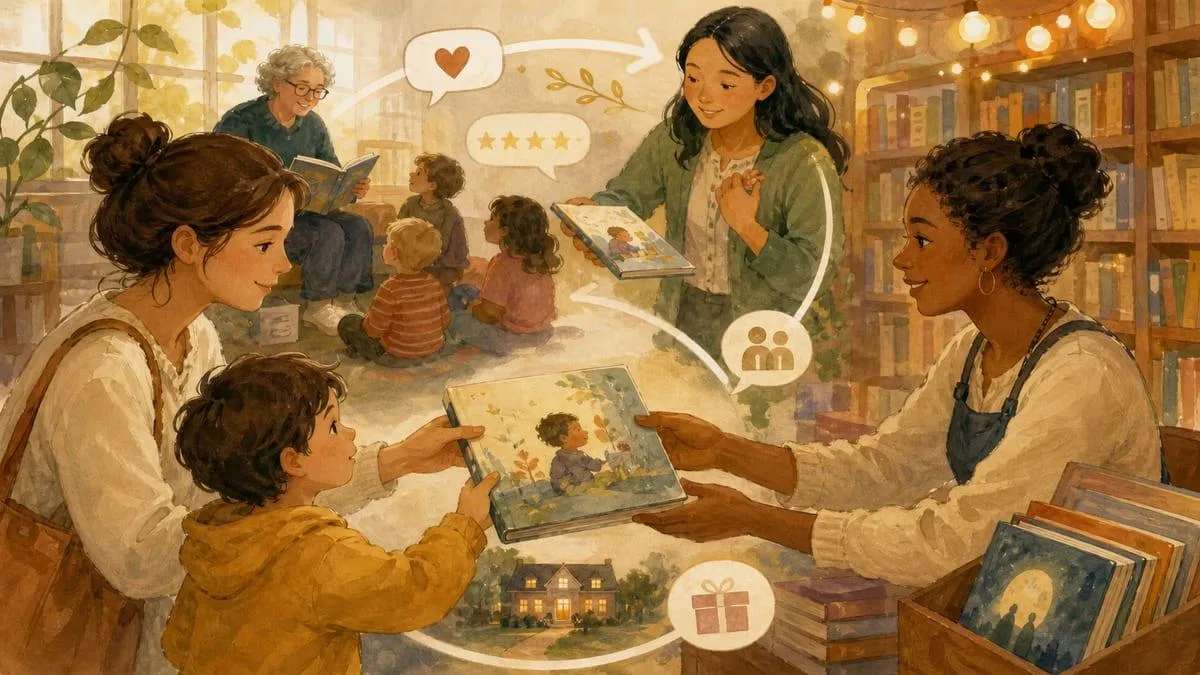
That is how small books travel. Not through huge billboards or front-window displays in every bookstore, but through one parent saying, “This helped us.”
Why Indie Books Need Word of Mouth
Big publishers often have sales teams, publicity lists, bookstore relationships, catalogue placements, professional review pipelines, and marketing budgets. Indie authors usually work with far fewer resources. Many are building everything slowly: the book, the website, the mailing list, the reader community, the school connections, the social media presence, and the courage to keep showing up.
That does not mean indie books are less worthy. It simply means their path to readers is different.
Book discovery is crowded. Parents are searching online. Teachers are sorting through resources. Librarians are balancing budgets, collection policies, supplier requirements, and community needs. Algorithms are unpredictable. Bookstores have limited space. Even a genuinely helpful children’s book can disappear quickly if no one talks about it.
This is why word of mouth matters so much. When a real parent, teacher, librarian, or caregiver recommends a real book in a specific context, it cuts through noise. It does what paid advertising often cannot do: it builds trust.
The Most Helpful Thing: Leave a Review
If you bought an indie children’s book and liked it, leaving a short, honest review is one of the most helpful things you can do.
It does not need to sound professional. In fact, it is usually better when it sounds like a real person wrote it. A simple sentence from a parent or teacher can help the next reader understand whether the book is right for their child, classroom, library, or family.
You could write something like:
“My daughter asked for this three nights in a row.”
“This helped us talk about body boundaries in a calm way.”
“My class loved the illustrations and had so many questions afterward.”
“A sweet Father’s Day gift. My child recognized our family in it.”
“Great for a space-loving child who likes facts but still wants a story.”
Reviews help future readers answer practical questions: Is this age-appropriate? Is it gentle? Is it fun? Is it useful? Did children actually respond to it?
That said, reviews should always be honest. If you received a free copy, it is best to disclose that where appropriate. The FTC expects material connections, such as free products, payments, or other benefits connected to endorsements, to be disclosed clearly. Platforms such as Amazon also have rules around customer reviews and may remove reviews that violate their guidelines.
Share the Book in Context
A flat “buy this book” post may not do much. A specific recommendation is far more useful.
Instead of writing, “Check out this book,” you might say, “We used this book to talk about safe and unsafe touch with our preschooler, and it made the conversation much easier.” Or, “If your child is obsessed with planets, this one made Pluto funny and memorable.” Or, “This bedtime book helped us slow down after a very overstimulating day.”
Context matters because parents and teachers are rarely looking for “a book” in general. They are looking for a book that solves a small real problem or fits a specific moment. They may need a gentle body safety book, a funny space book, a calm bedtime book, a book about big feelings, a Father’s Day gift, a classroom read-aloud, or a story that helps a child feel seen.
When you share why a book worked for your child, you make the recommendation useful.
Ask Your Library
Many parents do not realize they can request books from their local library.
Will every library order every indie book? No. Libraries have collection policies, budgets, supplier preferences, professional review requirements, space limitations, and community priorities. Some libraries have local author collections. Some prefer books available through established distributors. Some respond strongly to patron requests.
But a parent's request can still matter because it shows reader demand. A request from a family in the community may carry a different kind of weight from an author simply saying, “Please stock my book.”
If you love a book, search your library catalogue. If it is not there, check whether your library has a purchase suggestion form. You can keep the request simple and respectful:
“I would love to request this children’s picture book for the collection. It may be useful for families looking for books about body safety, STEM, bedtime, family, sports, emotions, or classroom read-alouds.”
The American Library Association also notes that author and illustrator visits can be a meaningful way to connect children and families with books and reading, which is another reason local interest and reader recommendations can matter.
Tell a Teacher or School Librarian
Teachers and school librarians are often looking for books that connect to real classroom needs: feelings, kindness, science units, weather, plants, space, personal safety, family celebrations, growth mindset, cultural representation, and read-aloud rhythm.
If an indie book fits one of those needs, tell them. Even better, mention how your child responded. “My child asked great questions after this one” is useful information. So is “This helped us talk about consent in a calm way” or “This worked well for bedtime because it was gentle, not overstimulating.”
A thoughtful recommendation does not pressure the teacher or librarian. It simply helps them discover a book that may serve their children or students.
Buy Directly at Events When You Can
If you meet an indie author at a book fair, school event, library day, pop-up, or market, buying directly can mean a lot. It often gives the author a better chance to connect with readers and explain the story behind the book.
It also gives your child a memory around the book: “We met the author. She signed this for you.”
That memory can make the book feel more personal. Children often love knowing that a real person made the story they are holding.
If you cannot buy, you can still support the author. Stop and talk. Take a card. Follow their page. Share the event afterward. Tell another parent who may be interested. Small actions still help.
Comment with Real Words
On social media, a real comment helps more than silent appreciation.
Instead of only liking a post, you could write, “This looks perfect for my space-loving 5-year-old,” or “I love books that help with bedtime anxiety,” or “Adding this to our Father’s Day gift list,” or “This topic is so needed.”
Real comments tell the platform that the post is worth noticing. More importantly, they tell other readers what is connecting. A thoughtful comment can give another parent the small push they need to click, save, share, or buy.
For indie authors, those comments are also feedback. They help authors understand what families and teachers are responding to.
Gift Small Books Intentionally
Picture books make beautiful gifts because they can become part of a family routine. A toy may be played with for a while and forgotten, but a book can become a bedtime ritual, a classroom conversation, a keepsake, or the story a child asks for again and again.
For Mother’s Day, a book like She Is So Much More can help children celebrate the woman behind “Mom.” For Father’s Day, How Dads Show Up can honour the everyday, imperfect, playful ways dads love. For birthdays, a STEM book can meet a child’s current obsession. For a new school year, a bravery or friendship book can support a transition. For a difficult conversation, a body safety book can help a parent begin gently when they do not know where to start.
When you gift a book, add a short note saying why you chose it. That note becomes part of the gift.
Invite Authors Into Real Opportunities
If you are connected to a school, bookstore, library, parenting group, podcast, newsletter, homeschool community, therapy practice, speech clinic, local event, or community organization, think about whether an indie children’s author could add value.
Many authors are happy to do readings, workshops, Q&As, storytimes, author talks, or themed sessions. The key is fit. A body safety author may fit a parent education night. A STEM author may fit science week. A bedtime author may fit a new parent group. A sports book may fit a community activity day. A Mother’s Day or Father’s Day book may fit a seasonal school or library display.
Small opportunities compound. One reading can lead to one classroom conversation. One classroom conversation can lead to one family buying the book. One family can lead to another recommendation. That is how small books begin to move.
What Not to Do
Support does not have to become pressure. Do not promise a review and then feel guilty forever if life gets busy. Do not leave a fake review. Do not pressure friends to buy a book they do not need. Do not assume indie means unprofessional, but do choose books thoughtfully. Do not message an author only to ask for free copies unless there is a clear, respectful reason.
Good support should feel honest, not forced.
The most useful support is simple: buy if the book is right for you, review if you genuinely read it, share if it helped, recommend it in the right context, and request it where it makes sense.
Why This Matters
Indie children’s authors often write into gaps they have personally felt. A book about a child who needs words for body safety. A book about girls and sports. A book about seeing science as wonder. A book about family love that feels ordinary and real. A book about bedtime for children who struggle to settle. A book about a feeling a child has but cannot yet explain.
When parents, teachers, librarians, and caregivers support these books, they are not only supporting one author. They are helping widen what children get to see, feel, ask, understand, and become.
A small book can become a big part of a child’s life.
But first, someone has to help it travel.
A Note from ChatterChirps
At ChatterChirps, our books are created for families, teachers, and caregivers who want stories that open gentle, meaningful conversations with children. Some books are about body safety and boundaries. Some are about science, space, weather, water, sports, family love, bedtime calm, confidence, or everyday kindness.
Every time a parent leaves a review, a teacher recommends a book, a librarian considers it for a collection, or a reader shares a post with a friend, it helps one of those stories reach another child.
That is why support matters. Not because small authors need applause, but because the right book can meet the right child at the right time.
Related Articles:
Why Reviews Matter So Much for Indie Children's Books — And Why They're So Hard to Get