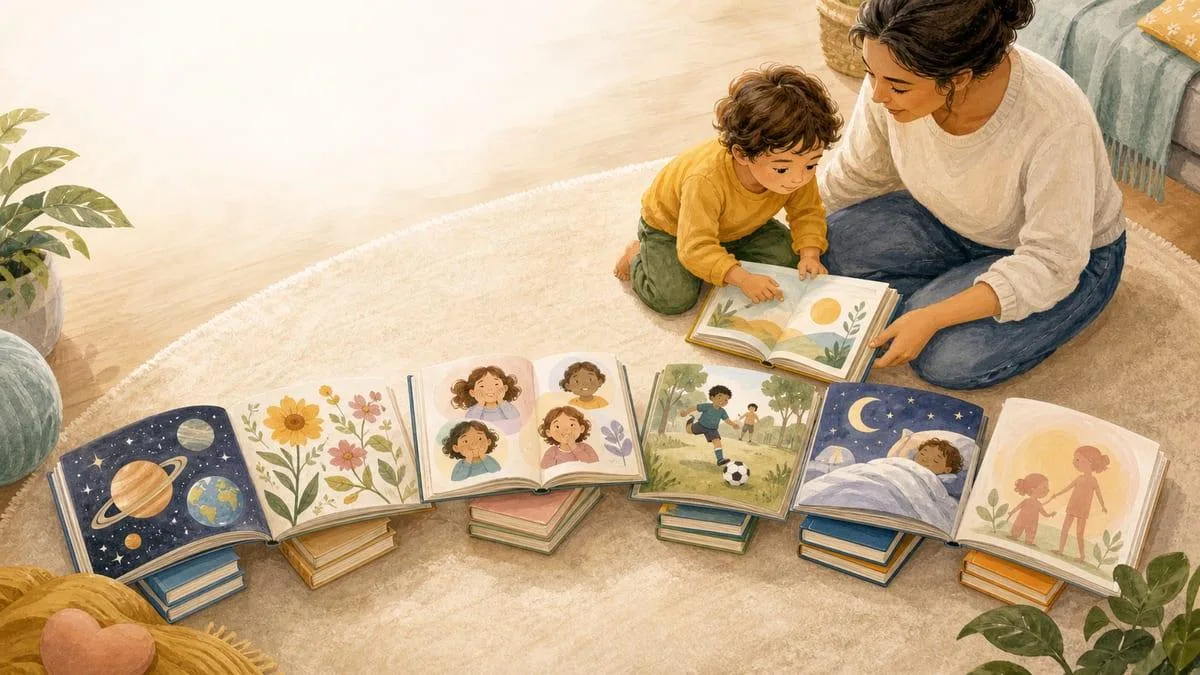
A good children's book can teach a child the name of a planet.
A better one can also teach them to ask questions.
A good children's book can show a child what bravery looks like.
A better one can help them recognize the tiny brave thing they did that morning.
That is the quiet power of picture books. They can hold more than one kind of learning at the same time.
As parents, we often search for books by topic: bedtime books, STEM books, body safety books, books about feelings, books about family, books about kindness. That makes sense. We are usually trying to solve a real-life moment.
But the books children return to again and again usually do more than check a topic box.
They make the child feel something.
Start with the child, not the lesson
Before asking, "What should this book teach?" ask, "Where is my child right now?"
Are they asking how rain works?
Are they scared of trying something new?
Are they obsessed with space?
Are they struggling to sleep?
Are they learning to say no?
Are they curious about bodies?
Are they becoming more independent?
Are they starting school?
Are they missing someone?
Are they learning that other people have feelings too?
The right book meets the child at that emotional address.
This is why a book about bees can also be a book about teamwork. A book about sports can also be a book about confidence. A book about bedtime can also be a book about safety and calm. A book about body boundaries can also be a book about trusting your voice.
Children do not separate learning into neat adult categories. Their minds are wonderfully messy. A story can feed all of that.
Look for books that invite conversation
Research on dialogic reading shows that children benefit when adults do not simply read at them, but talk with them during shared reading. Dialogic reading uses prompts, questions, and conversation to build language and comprehension.
That does not mean you need to turn every page into a quiz.
It means you can pause gently:
"What do you notice?"
"How do you think she feels?"
"What would you do?"
"Have you ever felt like that?"
"What do you think will happen next?"
A strong picture book gives you natural places to ask those questions.
If every page is only delivering information, the child may learn facts but miss the relationship. If every page is only moral instruction, the child may feel managed instead of moved.
Look for story first. The learning should live inside it.
Choose books that give children words
One of the greatest gifts a book can give a child is vocabulary for their inner life.
A child who can say "I'm nervous" is safer than a child who only knows how to melt down.
A child who can say "I need space" has more options than a child who only pushes.
A child who can say "That made me uncomfortable" has language adults can respond to.
A child who can say "I wonder why" has entered the doorway of science.
This is why books about feelings, body safety, STEM, and family all matter. They are not separate from literacy. They are part of how children learn to name the world.
The National Literacy Trust connects reading for pleasure with confidence, empathy, wellbeing, and learning. That makes sense to any parent who has watched a child use a phrase from a book days later in real life.
The book gave them the words first.
A simple checklist for choosing a book
The next time you pick a children's book, try this:
- Is the language enjoyable to read aloud?
If you dread reading it, your child may feel that. Rhythm, warmth, humour, and musicality matter.
- Does the book respect the child?
Children can handle big ideas when they are offered gently. Look for books that do not talk down to them.
- Is there something to notice in the pictures?
Illustrations are not decoration. For young children, pictures are part of the text.
- Does the book open a conversation?
A good book leaves space for your child's thoughts.
- Is the message shown through story?
Children usually absorb lessons better when they feel them through characters, not when they are lectured.
- Will this book still matter after the first reading?
Some books are useful once. Others become part of family language.
Books can teach facts and feelings together
At ChatterChirps, I often think in pairs.
Pluto's Guide to the Planets teaches space facts, but it also gives Pluto personality. Children learn astronomy through voice, humour, and curiosity.
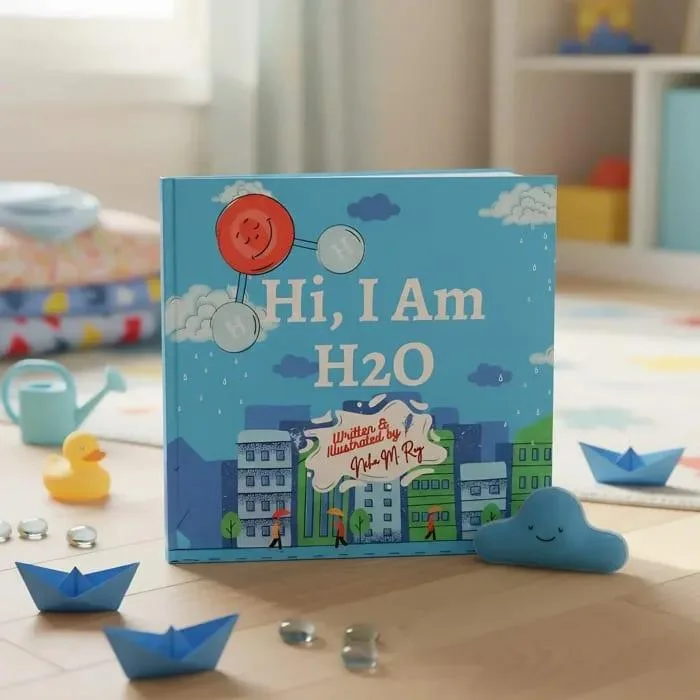
Hi, I Am H2O! can introduce a water molecule, but it also invites children to see science as something alive in everyday life.
Blooming with Daisy: A Sunflower's Journey teaches a plant life cycle, but it also carries patience and growth.
All the Sports I Can Play introduces different sports, but it also says, quietly, "You can try. You can move. You can belong."
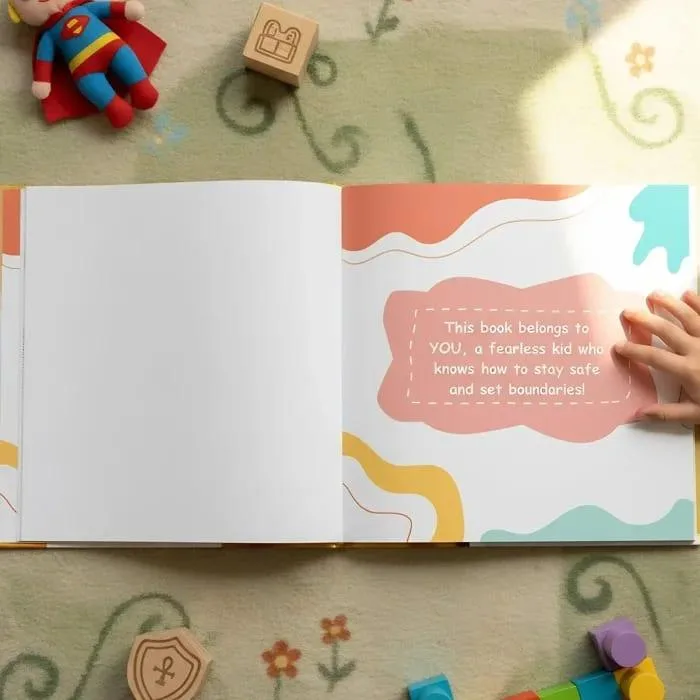
NO! STOP! TELL! My Body, My Rules! teaches body safety, but it also builds confidence, trusted-adult language, and the idea that a child's voice matters.
Rest Easy: A Nighttime Journey supports bedtime, but it is also about slowing down, breathing, and feeling safe enough to rest.
That is the kind of layering I love in children's books.
Do not underestimate joy
Sometimes parents feel pressure to choose "important" books.
Important is good. But joy is important too.
A funny book teaches timing, prediction, language play, and emotional release. A silly rhyme can build phonological awareness. A dinosaur adventure can lead to geology. A book about a lost kite can become a conversation about friendship and trying again.
If your child laughs, points, repeats, asks for it again, or acts it out later, the book is working.
Build a mixed bookshelf
A strong bookshelf might include:
- silly books
- bedtime books
- factual books
- books about feelings
- books about bodies and safety
- books about family
- books with children who look like yours
- books with children who do not
- books about nature
- books about machines
- books about art, music, sports, and imagination
- books that are just beautiful
The mix matters because children are not one thing.
They are curious and tired. Brave and unsure. Scientific and emotional. Loud and tender. Practical and imaginative.
Their books should make room for all of that.
The best question to ask after reading
When the book ends, try not to rush into, "Did you like it?"
Ask:
"What stayed with you?"
A child may point to a picture. They may repeat a phrase. They may say something completely unexpected. That answer tells you what the book gave them.
And sometimes, the answer comes days later, when they use the book's words in the middle of ordinary life.
That is when you know the story went in.
Helpful sources:
National Literacy Trust, Reading for Pleasure: https://literacytrust.org.uk/reading-for-pleasure/
Dialogic Reading research overview: https://pmc.ncbi.nlm.nih.gov/articles/PMC4422048/
Scholastic Kids & Family Reading Report: https://www.scholastic.com/readingreport/home.html
NAEYC social-emotional health and books: https://www.naeyc.org/resources/pubs/yc/mar2018/promoting-social-and-emotional-health