
Most parents know they should talk to their children about body safety.
Many still do not know how to begin.
The words feel too big. The topic feels frightening. We worry about saying too much, too soon. We worry about making children anxious. We worry about stealing innocence when what we really want is to protect it.
So the conversation gets postponed.
But body safety does not have to begin as one heavy, dramatic talk.
It can begin gently, with a picture book, a bath-time sentence, a bedtime question, a reminder before a playdate, a calm phrase repeated often enough that it becomes part of a child's inner voice.
Children need language before they need danger stories
A young child does not need graphic explanations to learn body safety.
They need simple, steady truths:
My body belongs to me.
Private parts are private.
I can say no to unwanted touch.
I do not have to keep unsafe secrets.
If something feels wrong, I can tell a trusted adult.
If one adult does not listen, I can tell another.
It is never my fault if someone breaks a body safety rule.
Resources from NSPCC's Talk PANTS campaign emphasize that children should understand their body belongs to them and that they should tell a safe adult they trust if anything makes them upset or worried. RAINN also encourages regular, age-appropriate conversations about boundaries and consent, while reminding adults that prevention is a shared responsibility.
That last part matters.
Body safety education is not about putting the burden on children. Adults are responsible for creating safe environments. But children still deserve words.
Why picture books help
A body safety book gives parents something to hold onto.
Instead of starting from fear, you start from a story.
You can pause on a page and say:
"What could the child say here?"
"Who is a trusted grown-up in our family?"
"What does your body feel like when something is not okay?"
"Can you always tell me, even if you feel embarrassed?"
The book becomes a third thing in the room. It softens the conversation. It gives children examples without making the topic feel like a warning siren.
For many families, that is the difference between avoiding the conversation and actually having it.
Use correct body-part names
Many child safety educators recommend teaching children accurate names for body parts.
This does not have to be awkward. You can say the words with the same calm tone you use for elbow, knee, or tummy.
Children learn from our comfort.
When adults use secretive or silly language only for private parts, children may absorb shame or confusion. Clear language helps children communicate if they are hurt, uncomfortable, or unsafe.
You do not need to turn it into a lecture. Just make correct language normal.
Teach boundaries in everyday moments
Body safety is not only about danger. It is also about everyday respect.
When a child does not want to hug someone, we can say, "You can wave instead."
When we help with bathing, we can say, "I am helping you wash because you are still learning. Private parts are private, and safe grown-ups only help for health, hygiene, or safety."
Before a doctor visit, we can say, "The doctor may need to check your body to keep you healthy. I will be there with you, and you can ask questions."
When siblings are roughhousing, we can say, "Stop means stop. We listen when someone says no."
These small moments teach consent without making it scary.
The trusted adult list
One of the most useful things you can do is help your child name safe adults.
Not just "tell someone."
Name them.
"You can tell Mama. You can tell Papa. You can tell Grandma. You can tell your teacher Ms. Lee. You can tell Auntie. If one person does not understand, you can tell another."
Children need repetition. They may not remember under stress unless the pathway has been practiced.
You can even make it visual: draw five trusted adults together and put the list somewhere private and familiar.
Secrets versus surprises
This is a powerful distinction.
Surprises are temporary and happy. A birthday gift is a surprise because everyone will find out soon.
Unsafe secrets are meant to be kept hidden, especially from parents or caregivers.
RAINN notes that perpetrators may manipulate children into hiding abuse by calling it a secret. So children need a rule they can understand:
"We do not keep secrets about bodies, touches, photos, or anything that makes us feel worried."
Again, say it calmly. Repeat it often.
Where NO! STOP! TELL! fits
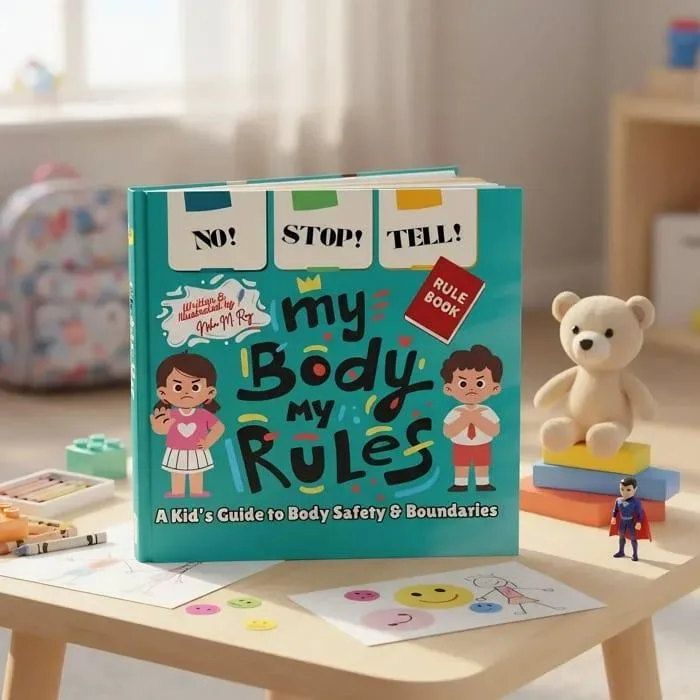
NO! STOP! TELL! My Body, My Rules! was written for exactly this kind of gentle beginning.
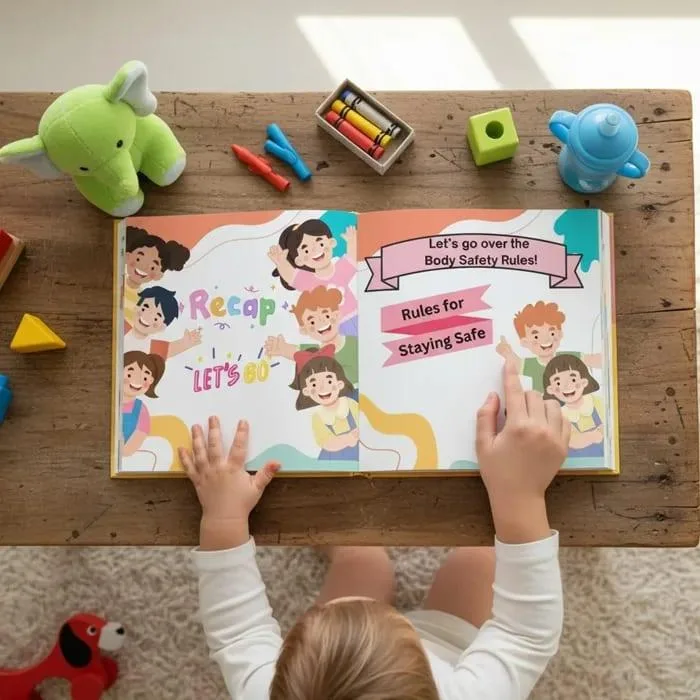
It teaches children the difference between safe and unsafe touch, the importance of personal boundaries, and the power of speaking up to a trusted adult. It is designed to empower, not frighten.
The title itself gives children a simple action path:
NO.
STOP.
TELL.
For young children, simple phrases matter. They become easier to remember when feelings are big.
As the author, and as a parent, I believe body safety books should never make a child feel responsible for adult wrongdoing. They should make the child feel believed, supported, and allowed to speak.
What not to do
Do not make every adult sound dangerous.
Do not force affection after teaching boundaries.
Do not use fear as the main teaching tool.
Do not ask children to manage adult emotions.
Do not say, "This could never happen in our family/community/school."
Do not make private parts shameful.
Instead, build a home where children know they can say uncomfortable things and still be loved.
A gentle script to begin
If you are not sure how to start, try this:
"I want to read a book with you about body safety. Your body belongs to you. Most people are kind and safe, but every child should know what to do if something feels wrong. You can always tell me anything about your body, even if you feel nervous or someone told you not to tell. I will listen."
Then read.
Let the book help.
Final thought
The goal is not to scare children.
The goal is to make safety speakable.
When children have words, trusted adults, and repeated permission to speak up, they are not losing innocence. They are gaining protection, dignity, and confidence.
And when parents have a book to begin with, the conversation becomes a little less impossible.
That is where we start.
Helpful sources:
NSPCC Talk PANTS: https://www.nspcc.org.uk/preventing-abuse/keeping-children-safe/underwear-rule/
RAINN, talking to children about boundaries: https://rainn.org/articles/talking-your-kids-about-sexual-assault
CDC child abuse and neglect prevention: https://www.cdc.gov/child-abuse-neglect/prevention/index.html
Fairfax County Body Safety Program: https://www.fairfaxcounty.gov/familyservices/children-youth/volunteer-partner-services/body-safety