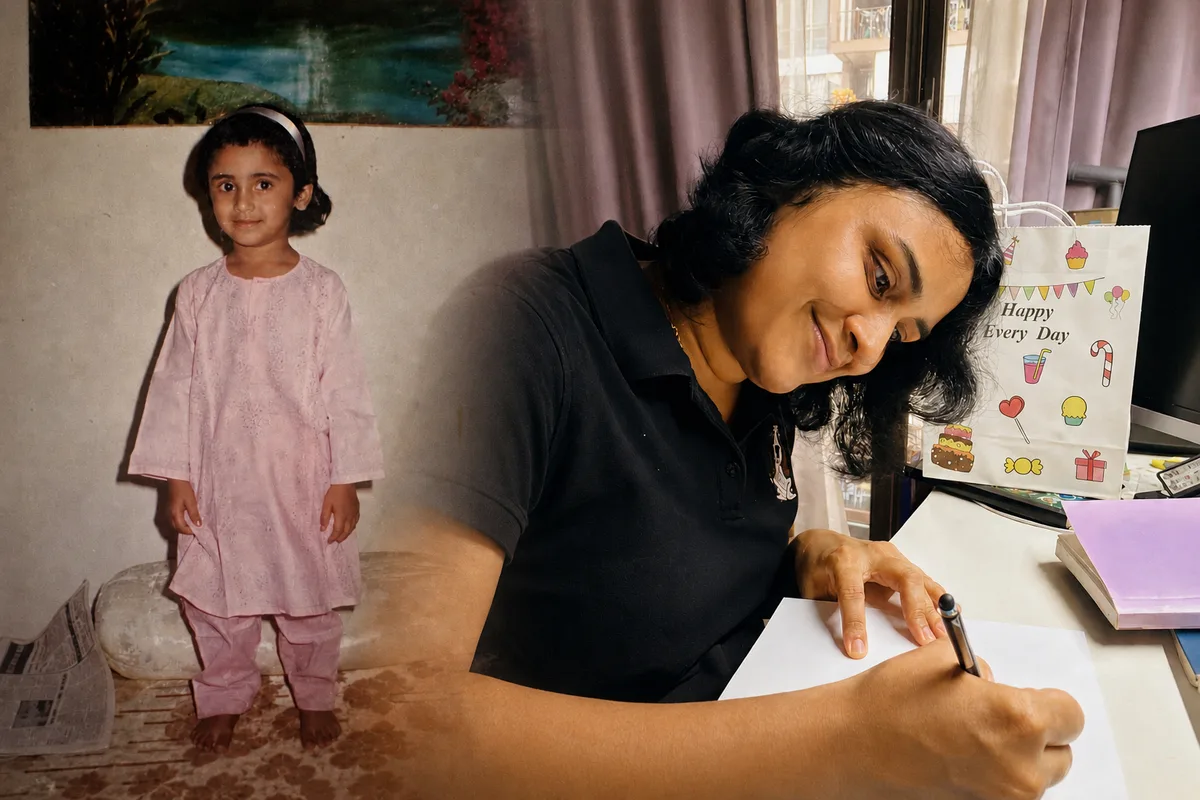
A Letter to the Little Girl Who Didn't See Herself in Books
BY NEHA MOGHE ROY | CHATTERCHIRPS
Today I turn 37. And birthdays do something to you — they make you look back before you can look forward.
So today, I want to write a letter. Not to my future self. Not to my daughter. But to that little girl in Bhopal who had a stack of comics taller than herself and absolutely no idea what she was quietly building inside.
Bhopal was small. Our dreams were not.
I grew up in a typical Maharashtrian Brahmin household — and I say that with so much pride. We weren't rich. But my parents had this quiet way of making everything feel like enough. They always said "we have enough" — and we believed them. It's only now, through little stories that slip out in conversations, that I've come to know there were months they bought groceries on credit. They never told us. Not once. Because in their eyes, what we needed — our education, our extracurriculars, our confidence — that was non-negotiable. Everything else could wait.
My elder brother was the one who started the reading obsession at home. He was deep into Doga and Super Commando Dhruv — the action-heavy, save-the-world kind. And because he read them, naturally, I did too. That's just how siblings work. You inherit each other's obsessions.
So while he was saving the world with Dhruv, I was deep into Chacha Chaudhary and Sabu. I was giggling through Pinki and Billu. I was reading Raman, Champak, Nandan, Bankelaal. I was not a doll girl — never was. I was a story girl. Give me a story and I would disappear into it completely.
We had so many comics at home we genuinely could have opened a lending library. That's a business idea I clearly missed.
I never noticed the gap. Not then.
Here's something I can say honestly now that I couldn't see as a child: there were almost no storybooks about girls playing sports. Not in my hands, not in my world.
And I wasn't just a child who liked sports. I was a national-level badminton player.
I know what it feels like to show up to school and practically beg girls to come and play — not for fun, just so we could put together enough players to submit a tournament entry. Most of my friends never chose sports. They weren't drawn to it. And I used to wonder — what if they had grown up reading picture books about children who played, who competed, who fell and got back up and tried again? Would sports have felt more like an option and less like an afterthought?
I didn't have those books as a little girl. And so, decades later, I wrote one. That's what All the Sports I Can Play is — a picture book for every child who needs to see that sport is for them. All of them.
These books existed somewhere, I'm sure. But they weren't in my hands. They weren't in my world.
Then my daughter showed me something I wasn't expecting.
She was two, maybe turning three. And she loved books the way I once loved comics — completely, unreasonably, with her whole body.
You know how it is in Indian homes — the TV is on, someone's talking on the phone, the pressure cooker is going off in the kitchen. Noise, always noise. And this tiny person would be sitting with a children's book and not hear a single thing. Not the television. Not us calling her name. Nothing.
For parents of a toddler, this focused, you know what comes next — people who didn't know her would see it and assume we were pushing her. Putting pressure on her at two years old. But any parent who has watched their child get truly lost in a picture book, without anyone asking them to, without a screen in sight — you know the difference. That's not pressure. That's a child who has found her thing.
And that child became my reason.
One night, I told her a bedtime story — made it up as I went, the way tired parents do. Her response was everything. The way she leaned in, the look on her face. That was the moment it crossed my mind: what if I made books for her? Maybe she'd love to read books by her mom.
That story became Little Star and Big Lesson: Belonging. My first children's book. Born in December 2024.
I wasn't afraid. But I was quietly unsure.
I want to be honest about this, because I think many first-time children's book authors carry this feeling — especially women, especially those of us who come from small towns and never planned to be authors.
It wasn't fear exactly. It was more like… "Who is going to care about this?"
People have work. They have their own children to raise, their own chaos to manage. Why would they stop and pick up a picture book by someone they'd never heard of?
And then my people showed up.
First — my husband. He has believed in me more than I have believed in myself. That kind of support doesn't make the news, but it makes everything else possible.
Then my parents — honestly, they need author copies of my books more than I do, just so they can show them to the world.
And then — my friends. Not in small ways, either. They shared my content before I had an audience. They reviewed my children's books when reviews were everything. Some of them did quality checks. Some just sent voice notes at midnight saying, "This is really good, keep going." I didn't expect that kind of love. I will never forget it.
The messages that stopped me in my tracks.
A few weeks after All the Sports I Can Play came out, a friend messaged me. He said, "I'm so proud — my son now knows the names of all the sports."
A child who now has words for things he sees in the world. That's what children's books about sports can do. That's exactly what I was hoping for. And it worked.
Then there was the mother who wrote to me about Pluto's Guide to the Planets. She said she was more obsessed with the book than her toddler was — staying up just to get lost in the illustrations and the imaginative world inside it.
I laughed. And then I sat with that for a while. Because that's what good picture books for children do that nobody talks about enough — they're not just for children. They're for the exhausted parent sitting cross-legged on the floor at 9 pm who suddenly, genuinely wants to know more about Pluto. They're for the adult who never got the simple, beautiful explanation they deserved when they were small.
If my early learning books are doing that — I'm doing something right.
To that little girl in Bhopal:
You didn't see yourself in those books. But you felt stories. You understood, even then, that stories are how we make sense of the world — the planets, the badminton courts, the big feelings nobody named for you.
You didn't know it yet, but you were going to grow up and write the children's books that fill the gaps. The sports books that didn't exist. The STEM books that make a toddler point at the sky and ask questions. The emotional learning stories give children language for what they feel.
Not from a big publishing house. Not with a literature degree. Just with that same stubborn, greedy love for stories that got you through stacks of Chacha Chaudhary in a small town where big things quietly began.
And it's going to matter more than you know.
Happy birthday to us. 🎂
Neha Moghe Roy is an award-winning children's book author and founder of ChatterChirps — a children's book brand for ages 0–8 built around emotional learning, early STEM, body safety, and stories that stay with children long after the last page.